
Locked And Loaded
US Macro, USD IG & KP Overview

Unless indicators significantly surprise, US 2YR long position remains probabilistically advantageous.
The credit market is expected to regain strength only if figures moderately undershoot consensus expectations. Maintain at least a 40% cash position a head of indicator releases.
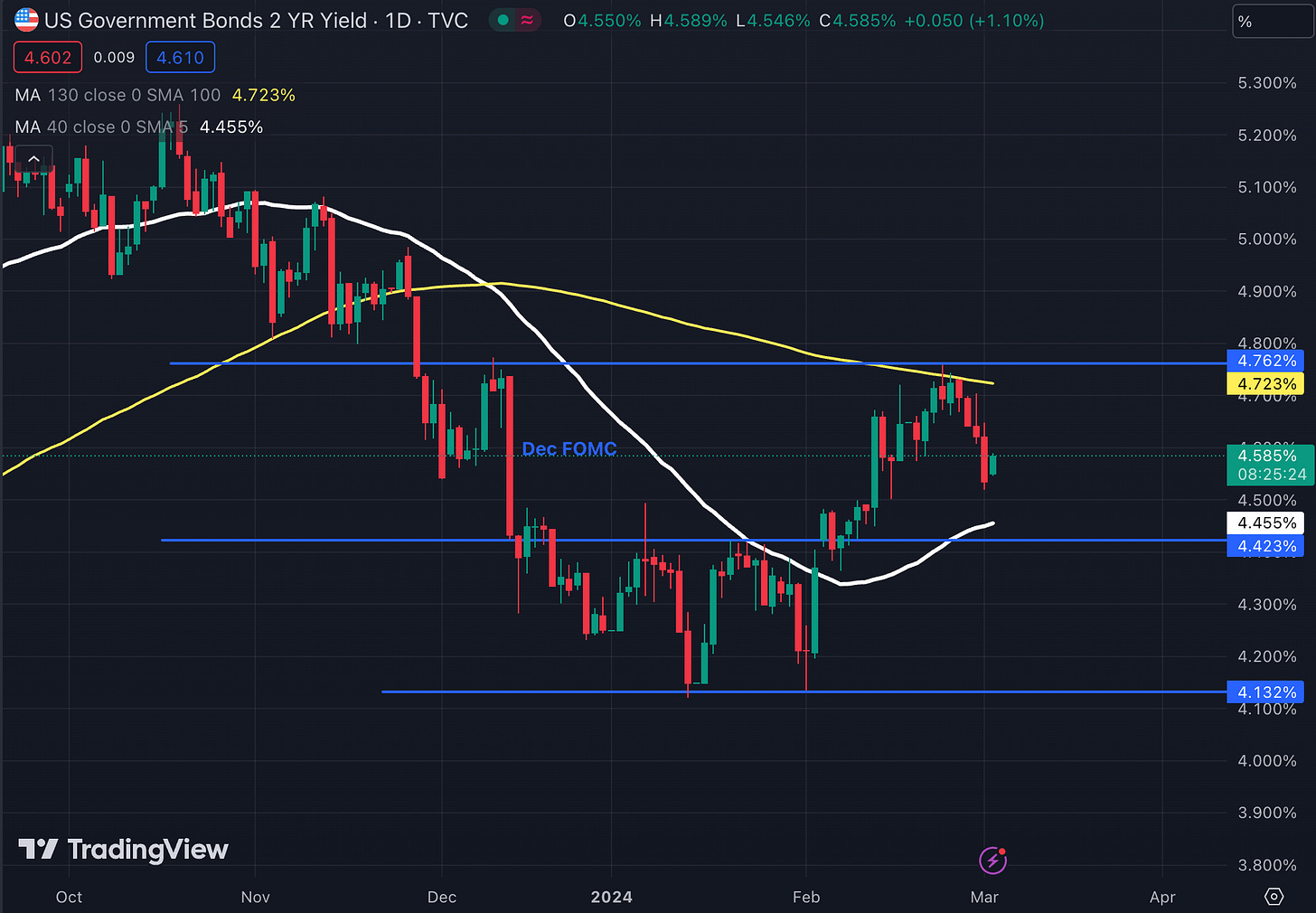
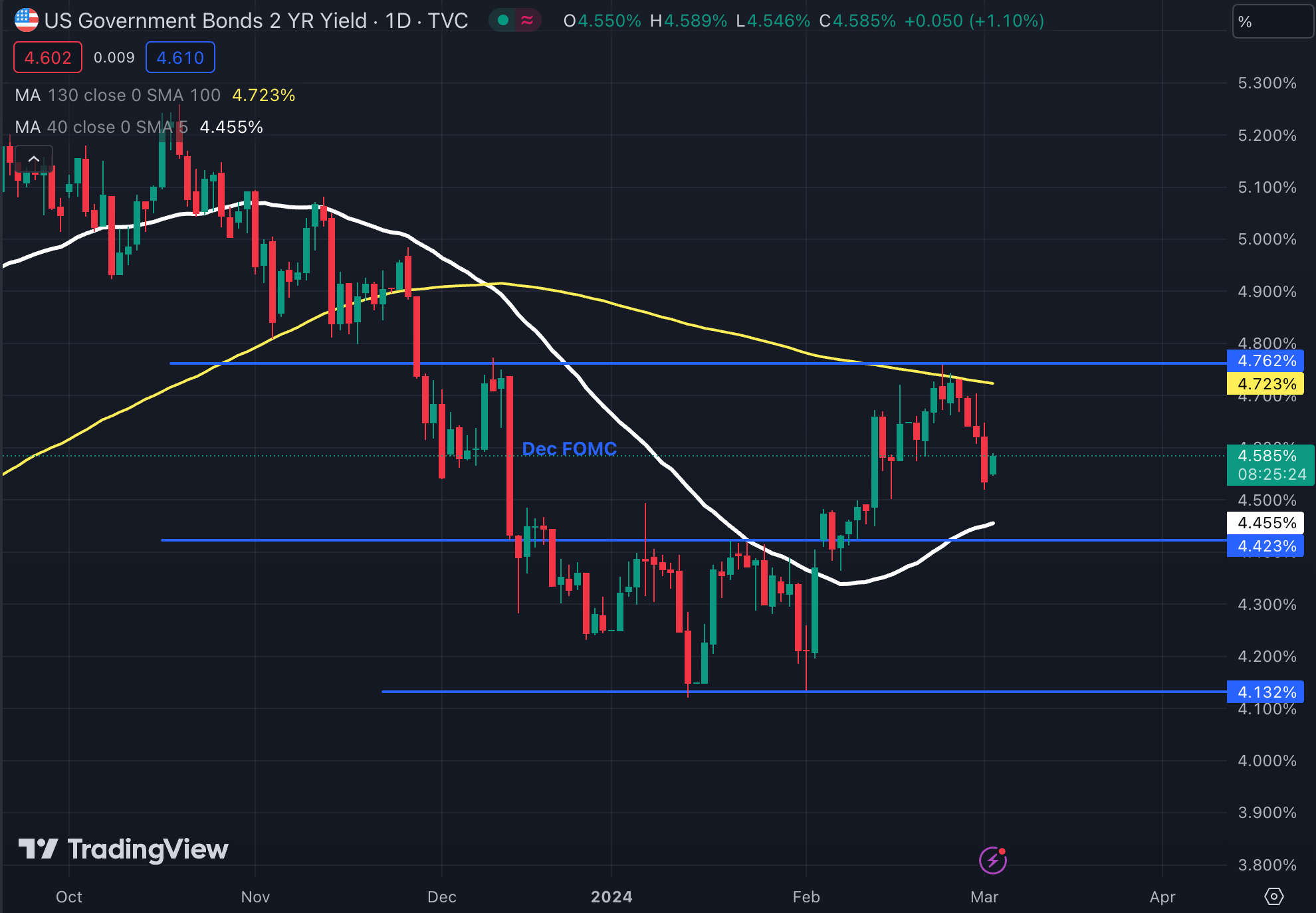
The week kicked off with the ISM Manufacturing Index, marking the start of a critical period for economic indicators. As anticipated, yields retreated after encountering resistance at the US 2YR @ 4.75%, a level aligned with expectations for three rate cuts within the year.
-
This threshold is set to be a pivotal reference for this month's strategy, consistent with the Federal Reserve's communicated stance, acting as an upper bound barring any significant surprises or misses in NFP or CPI reports.
Predicting outcomes for NFP or CPI to position long/short bets proves challenging, especially given the substantial noise from seasonal adjustments in NFP figures.
Consequently, a more efficient approach involves preemptively adjusting positions based on three potential outcomes: surprise, miss, or consensus alignment, thereby strategizing accordingly.
Should indicators surprise to the upside, as was the case with February's NFP and CPI releases, we might see a rollback of nearly one rate cut's worth of pricing each releases of NFP and CPI (15-20bp). A second consecutive month of unexpectedly strong data could raise doubts about the necessity for further rate cuts, potentially altering Fed officials' commentary and slightly incorporating a 0.5 rate hike possibility into the discourse. This scenario could lead to heightened implied volatility, making it difficult to predict the upper limit of rates. Unlike February, a significant correction in risk assets is anticipated under these conditions, with equity indices potentially retreating by up to 10%.
In the event of a miss, February's indicators will likely be dismissed as temporary, influenced by the "January effect," reestablishing the consensus that rate cuts are on track and slightly pricing in the first reduction in April. Yields could revisit the year's low of 4.15%, awaiting the next data release.
If indicators align with consensus, given the current cautious market sentiment towards this month's data, a bullish reaction is expected in the days following the announcement. However, the price range is anticipated to form between 4.40% and 4.75%, with the upper boundary reflecting the Fed's projected three rate cuts and the pricing range incorporating a slight expectation of a 4.5 rate cut scenario.
In summary, unless indicators significantly surprise, a long position remains probabilistically advantageous. Even in the case of a surprise, there's room to maneuver from the current level of 4.55% to the entry point. The strategy involves realizing half of the position entered at 4.65% and maintaining the long position for those entered at 4.73%, given the 20bp buffer, adjusting the remaining position only if indicators significantly surprise.
![[US Macro & USD IG Overview] Range Bound](https://substackcdn.com/image/fetch/$s_!E5JD!,w_140,h_140,c_fill,f_webp,q_auto:good,fl_progressive:steep,g_auto/https%3A%2F%2Fsubstack-post-media.s3.amazonaws.com%2Fpublic%2Fimages%2F21ea5bde-c400-4d6c-8c70-6209ba5ad913_2676x1382.png)
The credit market, after a notably strong mid-February, began showing signs of weakness as the month closed. The rally reached its zenith with spreads hitting historic lows (LQD), leading to a slight widening of individual issues by about 15bp from their lowest levels this year.
Despite the equity market reaching new highs, credits have showed weakness so far, I think mainly due to 1) the credit spread's range-bound nature, 2) the challenge of further spread tightening without dovish rate cut expectations, and 3) preemptive profit-taking ahead of March's indicator-heavy weeks.
Positions had been scaled back significantly in HYUELE,
(see my notes posted on 21st Feb)
which constituted the largest share of high-beta credit exposure. As credit began to underperform relative to equities, I incrementally liquidated additional high-beta credit holdings. Currently, the portfolio's composition is evenly split between high-beta credits and cash.
The scenario warranting utmost caution is one where indicators surprise to the upside. Under such circumstances, credit is expected to exhibit significant weakness, potentially widening spreads by more than 40 basis points.
This reversal stems from the shift in the previously capped interest rate ceiling, a primary driver of credit strength as argued in several past posts. With the real money bid that supported credit possibly evaporating, plans are in place to swiftly further reduce positions following the indicator releases.
Interestingly, too significant a miss in indicators like NFP could also weaken credit, particularly if it corroborates concerns raised by a substantial miss in the ISM Manufacturing Index.
In this context, the credit market finds itself in a precarious position, benefitting only from moderately lower-than-consensus figures.
Given the tight credit spread levels already pricing in a soft landing and orderly rate cuts, maintaining at least a 40% cash position is advisable ahead of indicator releases. Should conditions favor expanding long positions in credit, HYUELE will be the primary focus.